

Most companies spend enormous energy optimizing marketing channels, adjusting pricing, and improving conversion rates.
Yet one of the most powerful growth drivers is often overlooked: cross-team alignment for revenue growth.
When marketing, merchandising, product, and operations operate in silos, even well-funded campaigns struggle to convert. But when those teams align around a shared revenue strategy, growth accelerates.
Collaboration is not just an operational improvement — it is a revenue strategy.
The Hidden Cost of Marketing and Merchandising Silos
In many organizations, marketing owns demand generation while merchandising or product teams control offers, inventory, and pricing.
When these functions operate independently, the disconnect becomes obvious:
- Marketing promotes products with limited inventory
- Merchandising launches new products without marketing support
- Pricing changes happen without campaign alignment
- Campaign performance data never informs product decisions
The result is missed revenue opportunities, inefficient marketing spend, and inconsistent customer experiences.
Instead of operating as separate departments, these teams must function as a coordinated growth engine. High-performing organizations rely on a shared marketing promotions calendar to align product launches, campaigns, and seasonal demand across teams.
Why Cross-Team Alignment Unlocks Revenue Growth
When marketing, merchandising, and sales collaborate closely, several performance levers improve simultaneously.
Stronger promotions
Marketing campaigns become far more effective when tied to real product strategy, seasonal demand, or major launches.
Faster optimization
Shared performance data allows teams to quickly adjust messaging, pricing, or promotional structure.
Higher conversion rates
Customers see clearer offers and more consistent messaging across channels.
More efficient marketing spend
Paid media and email campaigns perform better when aligned with the right products at the right time.
Alignment turns marketing from a traffic generator into a revenue multiplier.
A Practical Example
A client operating a growing e-commerce business faced a common challenge: marketing campaigns and merchandising decisions were happening independently.
Product launches were sometimes under-promoted, while marketing campaigns occasionally focused on items with limited inventory or unclear positioning.
To address this, the leadership team created a more integrated planning model between marketing and merchandising.
This included:
- Coordinating campaign planning with product releases
- Aligning promotional messaging across channels
- Ensuring adequate inventory during key promotional windows
- Reviewing demand signals together on a regular cadence
The result was clearer promotions, improved campaign performance, and more predictable revenue during key demand periods.
The Shared Promotions Calendar: The Backbone of Alignment
Illustrative Example
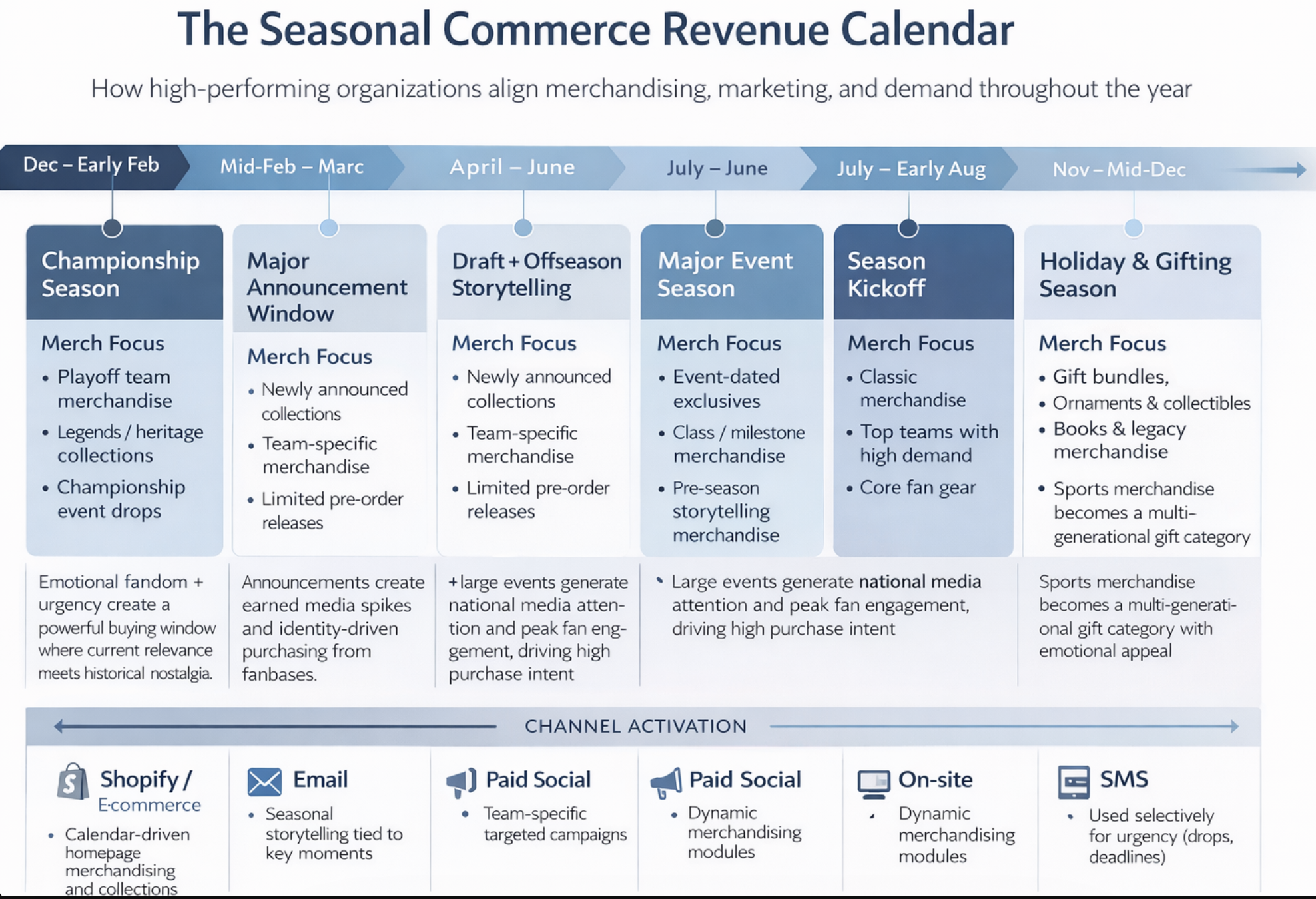
One of the most powerful tools for enabling cross-team collaboration is a shared marketing and promotions calendar.
This calendar becomes the central planning document that aligns marketing campaigns, product launches, promotions, and merchandising priorities.
When done well, it drives focus, prioritization, and accountability across teams.
A strong promotions calendar typically includes:
- Major promotional events and seasonal campaigns
- New product launches and inventory arrivals
- Content and email marketing campaigns
- Paid media flighting and campaign windows
- Cross-channel messaging themes
Rather than reacting to opportunities week-to-week, teams plan revenue-driving moments months in advance.
This creates clarity across the organization:
Marketing knows what to promote.
Merchandising knows what inventory to prioritize.
Operations can prepare for demand spikes.
The result is a more deliberate and coordinated revenue strategy.
Using Data to Forecast Demand and Plan Inventory
Alignment also enables smarter planning through data.
When marketing and merchandising teams share performance insights, they can begin to identify patterns in demand:
- Seasonal buying behavior
- Campaign-driven spikes in product interest
- Product category trends
- Customer purchasing patterns
These insights help teams estimate demand more accurately and make better decisions about inventory ordering and product availability.
Instead of reacting to demand after campaigns launch, teams can proactively ensure that the right products are available when marketing pushes traffic.
This reduces lost sales from stockouts and allows teams to confidently scale successful campaigns.
Unlocking Platform Optimization (Even During Slow Demand Periods)
Another advantage of cross-functional collaboration is the ability to fully leverage the capabilities of the commerce platform itself.
Platforms like Shopify provide a wide range of optimization opportunities that often go underutilized.
These include:
- Automated product recommendations and upsell flows
- Conversion optimization on product and checkout pages
- Bundling and merchandising experiments
- Email and SMS automation tied to product behavior
- Promotional pricing and limited-time offers
When marketing and merchandising teams collaborate closely, they can systematically test and optimize these platform features.
This becomes particularly important during slower demand periods, when growth must come from better conversion, stronger merchandising, and smarter promotion rather than simply more traffic.
Organizations that treat their platform as an active growth engine rather than just a storefront consistently outperform competitors.
What Leaders Should Implement Immediately
Executives looking to unlock growth through collaboration can start with a few simple actions.
Create a shared marketing and promotions calendar
Align campaigns, product launches, and seasonal demand across teams.
Establish regular cross-team growth reviews
Weekly or bi-weekly meetings ensure teams stay aligned on priorities and performance.
Build shared dashboards
Marketing, merchandising, and sales should review the same data and performance metrics.
Use demand insights to inform merchandising decisions
Historical data should guide inventory planning and product prioritization.
Treat the commerce platform as a growth engine
Continuously test merchandising, pricing, and conversion optimizations.
Collaboration Is a Revenue Strategy
Many companies attempt to grow by simply increasing marketing spend or launching new campaigns.
But the biggest gains often come from something simpler: getting teams to work together.
When marketing, merchandising, product, and operations operate as a coordinated system, every campaign performs better and every customer interaction becomes clearer.
Cross-team collaboration is not just good organizational practice.
It is one of the most powerful — and most overlooked — revenue growth strategies available to modern organizations.