

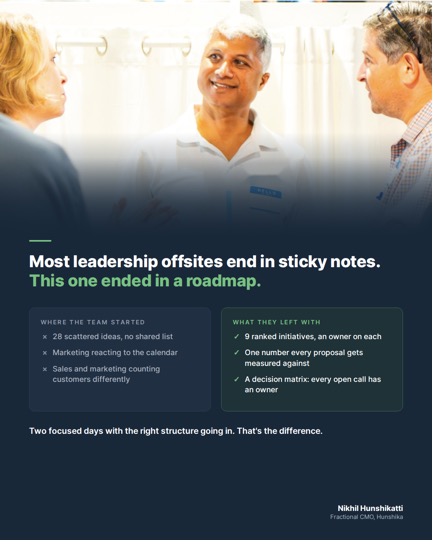
Most leadership offsites end with a wall of sticky notes and no owners.
This one ended with nine ranked initiatives, owners, a target quarter, and a short list to execute.
We will apply strategic planning offsite, leadership offsite agenda next time.
Key takeaways: The focus is the strategic planning offsite, leadership offsite agenda, how to prioritize initiatives, impact effort matrix, cross-functional alignment, marketing roadmap planning, strategic planning workshop facilitation. It yields a roadmap, not a wish list. To apply this, write outcomes before the agenda; settle unit economics before brainstorming; score each idea on impact and effort from 1 to 5; move small, obvious work to a separate ‘just do it’ lane; and ship a written readout within a day.
Why run a strategic planning offsite?
Run one when the team has more good ideas than it can rank and the functions aren’t working from the same numbers. Both were true here.
The client is a growth-stage, cash-pay telehealth brand with three lines of business: a core membership program, a diagnostics business and a newer supplements line. Growth was real but behind plan, and the leadership team could feel where the friction was:
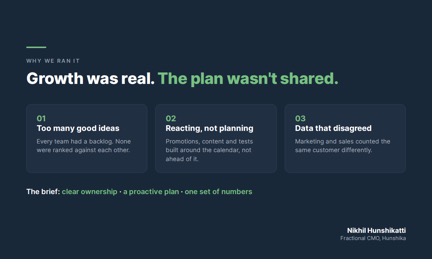
- Too many good ideas, no single list. Every team had a backlog, and none of them were ranked against each other.
- Marketing was reacting, not planning. Promotions, content and tests were built around the calendar instead of ahead of it.
- The data didn’t agree with itself. Marketing and sales counted the same customer differently, and nobody could say with confidence which channel was down on a given day.
The CEO’s brief was simple: leave with clear ownership, a proactive plan, and teams that work from the same numbers. Our job was to design two days that made those outcomes hard to avoid.
How do you prepare for a leadership offsite?
Agree the outcomes first, put what the business already knows into one pre-read, and have each session lead bring their own numbers. Most of the work happens before the room.
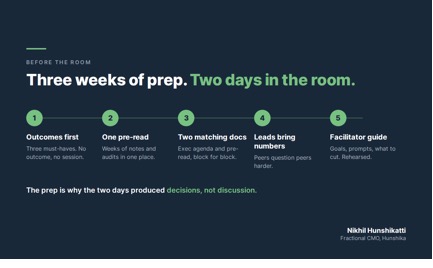
The workshop itself was two days. The prep took about three weeks, and it’s the reason the two days produced decisions instead of discussion.
- We wrote the outcomes first. Before any agenda, we agreed on three things the team had to leave with: a growth target with a return standard for every marketing dollar, a ranked roadmap with owners, and the team structure to deliver it. Every session had to feed one of the three, or it didn’t make the agenda.
- We built from what the business already knew. Weeks of meeting notes, email threads and audits went into a single pre-read: where the business stood, what the unit economics said, and which questions were still open. Nothing in the room should have been a surprise.
- We split the agenda into two documents. A one-page executive agenda for the leaders, and a fuller pre-read for everyone. They had to match block for block, and keeping them in sync took more revision than I expected.
- Session leads owned their own pre-work. Instead of the facilitator presenting everyone’s numbers, each session’s lead brought their own: performance metrics, the economics model, the tech roadmap. Channel owners prepared short updates of two or three slides. That shifted the room from listening to questioning.
- We wrote a facilitator guide. It listed what each session had to accomplish, the prompts that keep it on track, and what to cut if we ran late. I rehearsed it on the drive in.
What should day one of a planning offsite cover?
Set the numbers before you open the floor: where the business stands, what a customer has to be worth, and how you’ll measure it. Then brainstorm.
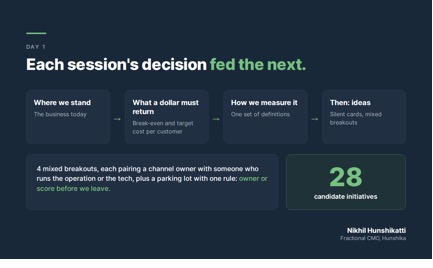
Day one ran as a chain: each session’s decision fed the next. We started with where the business stood, moved to what a marketing dollar has to return, then to how we measure it, and only then opened the floor to ideas.
We started with an icebreaker: each person wrote the headline they’d want written about the company at the end of next year, plus the one thing standing in the way. The headlines went on the wall. The blockers turned out to be a preview of the next three sessions.
The deliberations that mattered
A few conversations did most of the work.
- What does a customer have to be worth? The data lead walked the room from gross revenue per customer down to a break-even acquisition cost and a target that keeps a profit reserve. Once that number was on the wall, budget debates got shorter, because every proposal could be held against it.
- Is the near-term peak a campaign or the plan? The biggest sales window of the year was weeks away, and it decided how much of the annual gap could still be closed. The team agreed it was the top priority for every function, and then asked the harder question: what do we deprioritize to protect it?
- One business or three? The diagnostics and supplements lines were getting a small share of agency and team attention. The room didn’t settle whether to separate them fully, but it agreed the first step: get tracking right before splitting budgets or accounts.
- Whose number is it? Marketing and sales defined churn differently, and lead-source fields meant different things to different teams. Nobody was wrong; they had simply never been asked to agree.
The breakouts
We ran ideation as a group exercise, not an open discussion. First, ten minutes of silent ideas on cards, one idea per card, each tagged with the metric it would move. Then four small groups, each built to mix a channel owner with someone who runs the operation or the technology:
- the first six weeks of the customer experience;
- growth for the second and third business lines;
- content, attribution and organic velocity;
- paid and organic performance.
Anything that came up out of turn went on a parking lot, but with a rule: every item gets either an owner or a score before we leave. By the end of day one, the breakouts and the parking lot together held 28 candidate initiatives.
How do you prioritize initiatives in a workshop?
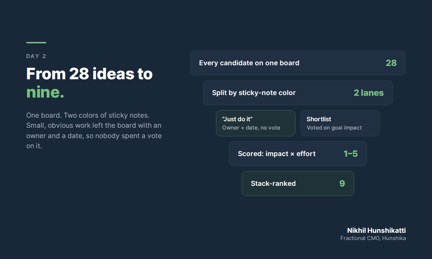
Put every idea on one board, pull out the small obvious work, score the rest on impact and effort, then stack-rank together and give each item an owner. On day two, that took 28 candidates down to nine, plus a “just do it” lane.
The morning went deep on the topics that would shape the ranking: the plan for the peak sales window, lead-source attribution, the patient portal and app roadmap, a new subscription model, and how to resource the smaller business lines. One theme kept coming back. Attribution wasn’t a reporting nice-to-have; it was the blocker under lifecycle, sales follow-up and paid retargeting all at once. That conversation largely decided the top of the roadmap before the scoring started.
How we prioritized
We had 90 minutes and 28 candidates. My first plan was to split the list across the breakout groups and have each one score its slice. In the room, we chose something simpler:
- Every initiative went on one board. Seeing the whole list in one place made the overlaps obvious, and several items merged.
- Two colors of sticky notes split the list. One color for items that needed ranking. The other for “just do it”: cheap, obvious, already owned, and doable in about 30 days. Those left the board with an owner and a date, and nobody spent a vote on them.
- The room narrowed the rest to a shortlist, voting for the items that would move the annual goal most.
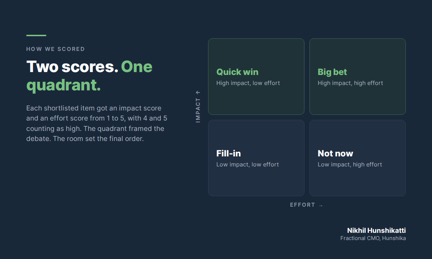
- Each shortlisted item got two scores from 1 to 5. Impact on the annual goal, and effort, with 4 and 5 counting as high. That places every item in a quadrant: quick win, big bet, fill-in or not now.
- The room stack-ranked the shortlist together and added an owner, supporting team, target quarter and rough cost to each.
The “just do it” lane did more than I expected. It took a whole category of argument off the table, because people stopped defending small, obvious work in a ranking it didn’t need.
We also walked through an illustrative org design in five lanes: paid acquisition, lifecycle, content and organic, the second business line, and growth operations. Each lane owns a slice of the funnel metrics, and an embedded tech and data pod reports to engineering but takes its weekly priorities from marketing. Putting the empty seats on a chart made the hiring case faster than any argument could have.
What should a planning offsite produce?
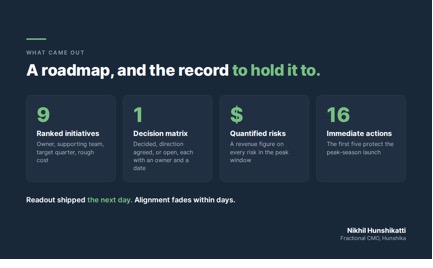
A ranked roadmap with an owner on every item, plus the record to hold it to: a decision matrix, quantified risks and immediate actions.
The team left with a ranked 2027 roadmap of nine initiatives:
- Lead-source attribution, the foundation everything else depends on
- The first six weeks of the customer experience: onboarding, lifecycle and getting to first value faster
- Organic growth through SEO and AI answer engines, with a target to roughly quadruple organic’s share of traffic
- Conversion rate optimization across all three business lines
- Attribution for the smaller business lines, moved to the “just do it” lane
- A subscription model test for the core program, on hold until next year so it doesn’t compete with the peak season
- A refer-a-friend program
- A shared messaging and tone-of-voice standard
- A subscription model for the diagnostics business
Each initiative has an owner, a supporting team, a target quarter and a rough cost.
Three other artifacts came out of the two days, and I’d argue they matter as much as the list:
- A decision matrix. Every call from the two days, marked decided, direction agreed, or still open, with an owner and a date. The open ones are visible rather than quietly dropped.
- Quantified risks. For the peak window, we put a revenue figure on every 10% shortfall, on each lost day of lead nurture, and on a compliance mistake in outbound dialing. A risk with a number on it gets a mitigation and an owner; a risk without one gets nodded at.
- Immediate actions. Sixteen, the first five aimed at protecting the peak-season launch the following week.
The readout went out the next day: the vision, a summary of each session, the decisions, the risks, the ranking, and a short list of things still to verify.
What makes a leadership offsite work?
Seven habits made the difference, and most of them happen before or after the room.
- Write the outcomes before the agenda. If a session can’t name which outcome it feeds, cut it.
- Make session leads bring their own numbers. People question a peer’s data harder than a consultant’s slides, and that’s the point.
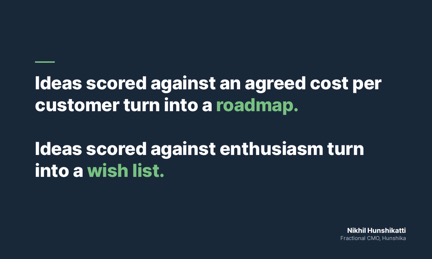
- Settle the economics before you brainstorm. Ideas scored against an agreed cost per customer turn into a roadmap. Ideas scored against enthusiasm turn into a wish list.
- Mix the breakout groups on purpose. Put a channel owner with someone who runs the operation or the tech. The best ideas came from the seams between functions.
- Give small, obvious work its own lane. “Just do it” keeps the ranking for real trade-offs.
- Put a number on every risk. It changes the conversation from “that could be a problem” to “who owns this, and by when.”
- Ship the readout fast. Alignment fades within days. A written record of decisions, owners and dates is what turns two days in a room into the next quarter’s work.
Frequently asked questions
What is a “just do it” lane?
A separate list for work that is cheap, obvious, already owned and doable in about 30 days. Those items get an owner and a date instead of a vote, so the ranking is saved for real trade-offs.
What is an impact-effort matrix?
A 2×2 grid that scores each initiative on impact and effort, usually from 1 to 5. It sorts items into quick wins, big bets, fill-ins and “not now,” which frames the prioritization debate.
How long should a strategic planning offsite be?
Two focused days is enough if the prep is done. Expect about three weeks of preparation: agreed outcomes, a shared pre-read, and session leads bringing their own numbers.
How many initiatives should a roadmap have?
Few enough that each one has a named owner and a target quarter. This team narrowed 28 candidates to nine.
What should happen after the offsite?
Send a written readout within a day or two with decisions, owners, dates, quantified risks and immediate actions. Then hold a monthly check-in against the roadmap.
The roadmap is only as good as the first monthly check-in. That’s next.
If your team has more good ideas than it can rank, and more owners than decisions, I’d be glad to compare notes.
Nikhil Hunshikatti is a Fractional CMO and founder of Hunshika, working with growth-stage brands on go-to-market strategy and growth planning.