

Estimated Reading Time: 8–10 minutes

One conversation with a client has stayed with me because it perfectly captured one of the biggest misconceptions about marketing attribution.
The company was growing.
Revenue was ahead of plan.
Marketing campaigns were producing more leads.
Conversion rates looked healthy.
Yet something wasn’t adding up.
Margins weren’t improving.
Customer acquisition costs were creeping upward.
Profitability wasn’t keeping pace with revenue.
The executive team’s question was straightforward:
“If marketing is working, why aren’t we seeing it in the bottom line?”
At first glance, it sounded like a marketing performance discussion.
It wasn’t.
It was an attribution discussion.
Because the real issue wasn’t whether marketing generated revenue.
It was whether the business could confidently connect marketing investments to profitable financial outcomes.
Those are two very different questions.
And they’re where many organizations begin to struggle as they grow.
What Is Marketing Attribution?
Marketing attribution is the process of determining which marketing activities influenced a customer’s decision to buy.
In simple terms, attribution attempts to answer one question:
“What actually drove this sale?”
That might sound simple.
It rarely is.
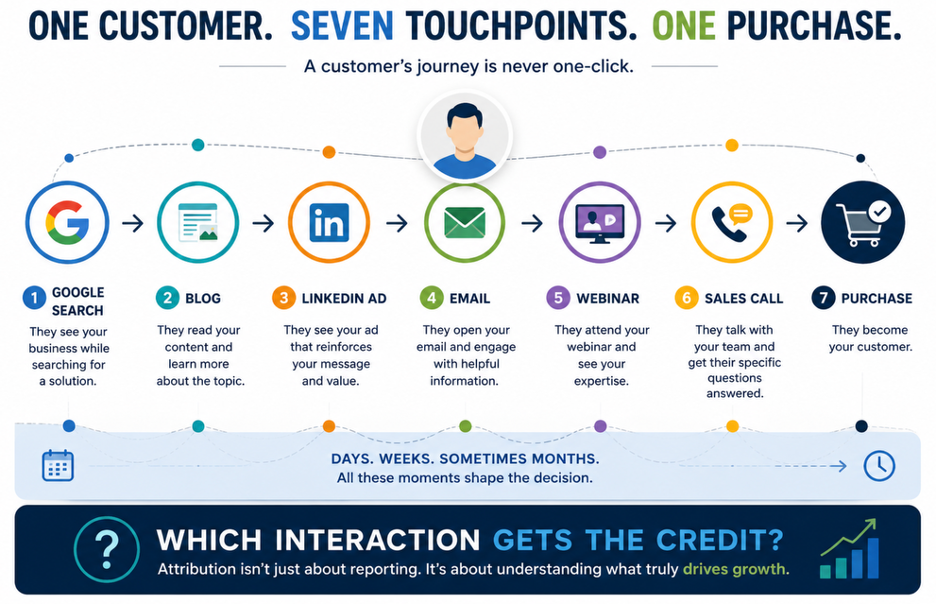
A customer may discover your company through Google.
Read several blog articles.
Receive an email nurture campaign.
Attend a webinar.
See a LinkedIn ad.
Speak with Sales.
Then purchase three months later.
Which interaction deserves credit?
The answer depends on the attribution model you’re using—but more importantly, it depends on what business question you’re actually trying to answer.
Too often, attribution is viewed as a marketing dashboard.
In reality, it’s a business decision-making framework.
Leadership teams rely on attribution to answer questions such as:
- Which investments deserve more budget?
- Which channels create the highest-quality customers?
- Where should we reduce spending?
- Which initiatives drive long-term profitability?
Marketing attribution isn’t just for marketers.
It’s one of the most important tools executives have for allocating capital wisely.
Why Attribution Gets Harder as Companies Grow
In small organizations, attribution often feels straightforward.
A prospect clicks an ad.
They submit a form.
They become a customer.
Growth changes everything.
As organizations scale, attribution becomes exponentially more complicated.
Longer Sales Cycles
Enterprise purchases may take weeks—or months.
Multiple stakeholders influence the buying decision.
Several campaigns contribute over time.
Single-touch attribution quickly falls apart.
More Marketing Channels
Companies invest across:
- Paid Search
- Organic Search
- Social Media
- Events
- Partnerships
- Content Marketing
- Direct Sales
Every interaction influences customer behavior differently.
Revenue Recognition Doesn’t Always Match Customer Behavior
One client recently highlighted this perfectly.
A customer completed a purchase during the final days of May.
From marketing’s perspective, the campaign generated a May conversion.
From finance’s perspective, the revenue wasn’t officially recognized until June.
Neither team was wrong.
They were simply measuring different outcomes.
Now multiply that scenario across hundreds or thousands of transactions each month.
Suddenly, campaign reporting no longer aligns neatly with financial reporting.
That’s where many attribution systems begin to break down—not because the technology failed, but because the business processes became more complex.
Operational Complexity
As companies mature, additional factors enter the equation:
- Returns
- Refunds
- Shipping costs
- Discounts
- Channel margins
- Sales commissions
- Inventory timing
Marketing may celebrate revenue growth.
Finance may see shrinking margins.
Operations may see fulfillment challenges.
Everyone is technically correct.
They’re simply looking at different versions of success.
The Biggest Marketing Attribution Challenges
After working with organizations across different industries, several patterns emerge repeatedly.
Revenue Growth Doesn’t Always Mean Profitable Growth
Revenue is exciting.
Profit funds the future.
Marketing often celebrates customer acquisition.
Finance evaluates contribution margin.
Leadership needs both.
If acquisition costs rise faster than customer value, revenue growth becomes increasingly expensive.
Without connecting attribution to profitability, organizations risk scaling inefficiency.
Marketing and Finance Speak Different Languages
Marketing asks:
- Cost per Lead
- ROAS
- CAC
- Conversion Rate
Finance asks:
- Gross Margin
- EBITDA
- Contribution Profit
- Cash Flow
Neither framework is wrong.
The challenge is that they rarely connect.
True attribution bridges those conversations.
Attribution Often Stops at Revenue
Many dashboards proudly report:
- Pipeline Created
- Revenue Generated
- Closed Deals
But they stop there.
The better question is:
Which marketing investments created the most profitable customers?
Those answers often look very different.
Attribution Isn’t a Marketing Problem
One of the biggest misconceptions I encounter is the belief that attribution belongs solely within marketing.
It doesn’t.
Marketing creates demand.
Sales converts demand.
Operations fulfills demand.
Finance recognizes revenue.
Leadership allocates investment.
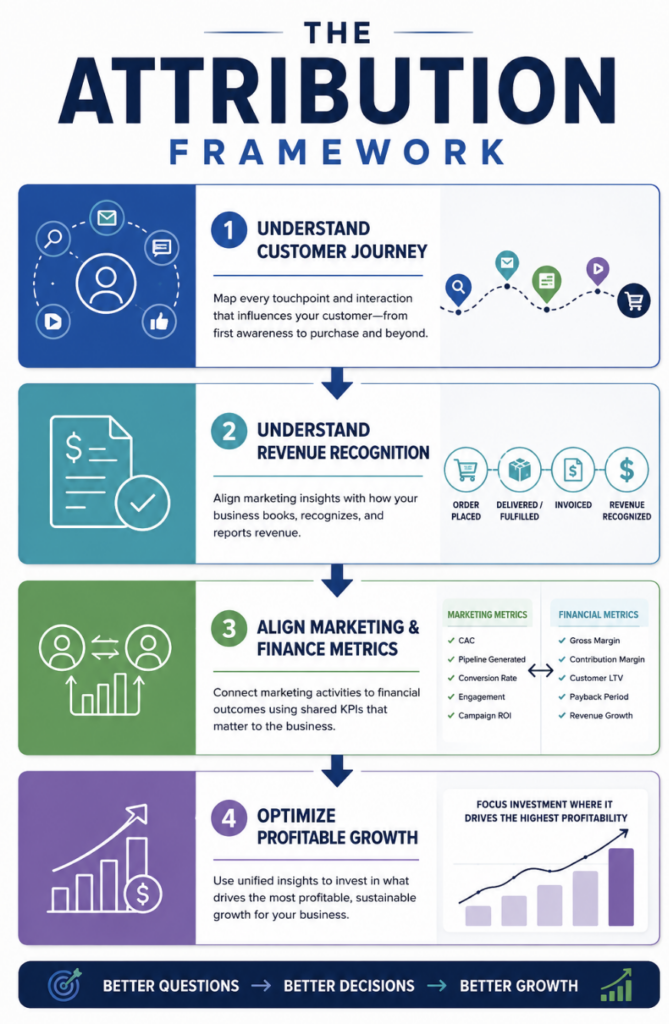
Attribution lives at the intersection of all five.
Attribution Should Inform Decisions, Not Just Reports
The purpose of attribution isn’t giving marketing more credit.
It’s giving leadership better information.
When attribution connects customer behavior, operational reality, and financial performance, executives make better investment decisions.
Budgets become smarter.
Forecasts become more accurate.
Growth becomes more profitable.
The organizations that excel at attribution aren’t necessarily using the most sophisticated software.
They’re asking better questions.
And that’s where meaningful marketing measurement begins.
Frequently Asked Questions About Marketing Attribution
Why is marketing attribution important?
Marketing attribution helps organizations understand which marketing activities influence customer decisions, allowing leaders to invest in the channels and strategies that generate the greatest business impact—not just the most clicks.
What are the different marketing attribution models?
Common marketing attribution models include:
- First-touch attribution
- Last-touch attribution
- Linear attribution
- Time-decay attribution
- Position-based (U-shaped) attribution
- Data-driven attribution powered by machine learning
Each model answers a different business question, so the “best” model depends on your organization’s objectives.
Why is marketing attribution so difficult?
Attribution becomes challenging because customers interact with multiple channels, sales cycles grow longer, revenue recognition differs from marketing conversion timing, and departments often define success using different metrics.
How does AI impact marketing attribution?
Artificial intelligence is transforming marketing attribution by identifying patterns across millions of customer interactions, improving predictive modeling, uncovering hidden channel relationships, and helping organizations move beyond rule-based attribution models toward probabilistic, data-driven insights.
If your marketing dashboards show growing revenue but your profitability tells a different story, your attribution model may not be answering the questions your leadership team actually needs answered.
Let’s talk about how to connect marketing performance with financial outcomes—so every growth decision is backed by the metrics that matter most.