

There’s a familiar moment most leadership teams hit when growth slows.
Pipeline softens. Conversion flattens. Revenue misses expectations.
And almost instinctively, the same conclusion shows up:
“We need more channels.”
More paid media. More content. More platforms. More experiments.
It feels proactive. It creates motion. It gives teams something to do.
But in practice, it’s usually the fastest way to make the problem worse.
The Myth
When growth stalls, adding channels will restart it.
Why This Myth Persists
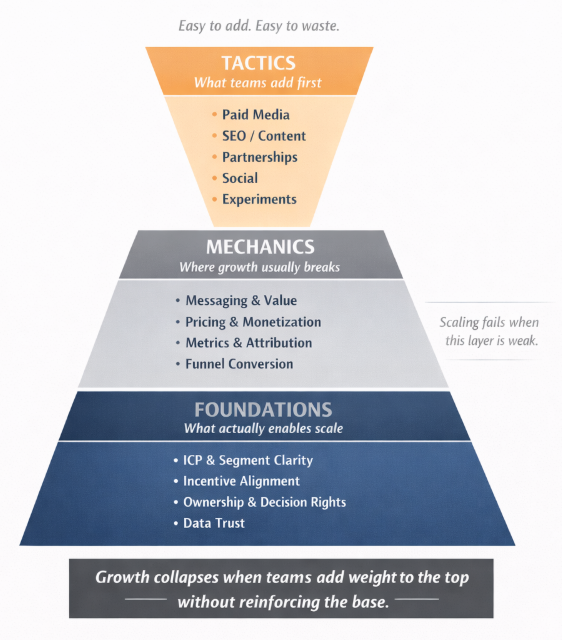
Channels are visible. They show activity and justify spend. They also avoid harder conversations about fundamentals: positioning, pricing, focus, and decision clarity.
Expanding channels feels reversible. Strategic choices don’t.
So organizations default to activity instead of diagnosis.
Where It Breaks
In real organizations, this shows up as:
- Rising CAC answered with channel expansion
- Messy attribution answered with more tools
- Flat performance answered with more content volume
The result isn’t acceleration — it’s diffusion.
The Real Constraint
In almost every stalled-growth situation I’ve worked on, the constraint wasn’t reach. It was one of five things:
- Unclear value propositions across segments
- Weak monetization mechanics
- Misaligned incentives between teams
- Low trust in data
- Execution drag from unclear ownership
No channel fixes those.
A Better Model
Before adding anything, answer four questions:
- Which segment actually drives profitable growth?
- Is efficiency or volume the priority right now?
- Which metric would we trust enough to bet a quarter on?
- What would we stop doing if forced to choose?
What I’d Do in the Next 30 Days
- Freeze channel expansion
- Identify the primary growth constraint
- Kill one low-impact activity
- Align leadership on one success metric
- Fix fundamentals before scaling
Growth rarely stalls because teams aren’t working hard enough.
It stalls because focus erodes before fundamentals are fixed.